A Very Important Day!
This English text is a machine translation of the Turkish original and may contain errors.
A Very Important Day!
About 3,500 years ago (1513 B.C.), through Moses, God delivered the Israelites from slavery at the hands of the Egyptians, who were the rulers of the world at that time. The Egyptians made their lives bitter as slaves. (Exodus 1:8-14) Who are the Israelites? To put it simply, they are the descendants of Isaac, the son of Abraham, whom God loved so much.
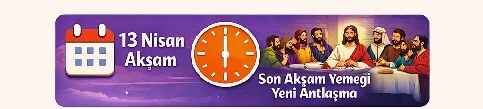
God ruled over Egypt with many miracles and wonders, and He also gave the Israelites laws that they were to keep. One of these laws was the Passover feast. It was a day the Israelites were to commemorate with gratitude, so that they would remember the day God delivered them from Egypt, from slavery. (Exodus 12:1-14) This day of deliverance, according to the Jewish calendar, takes place on the 14th of Nisan. The night before His murder, that is, the 13th of April — Jesus' Last Supper and the day on which the new covenant with all humanity is commemorated — falls in the year 2027 on Sunday, the 21st of March.
For us, however, the meaning is not the Passover. The day we are to commemorate is not the day of the Passover sacrifice, but the day before it, when at the meal Jesus Christ made a new covenant. The Christian world knows that day as Passover, but it is clearly written and evident in the Gospels that it was not so. Jesus did not eat the Passover that day. If that day had been the night of Passover, they could not have killed Jesus, or any prisoner, on the following day, which was both a feast and then, the day after that, the Sabbath (Sabbath/Shabbat). (Mark 15:42; John 18:27; 19:14; 19:31; 19:42)
And Jesus took bread, and when He had given thanks, He broke it and gave it to them, saying: This is My body which is given for you; do this in remembrance of Me. Luke 22:19
And continuing, He says the following:
And after the supper, He likewise gave them the cup, saying: This cup is the new covenant in My blood, which is poured out for you. Luke 22:20
The true followers of Jesus must be different from the others. Otherwise, exactly as people do all over the world, we will have commemorated/celebrated not Jesus' new covenant but the Passover, which fulfilled the old law. All of humanity outside of Israel, that is, we, were not slaves in Egypt. But all humanity is a slave to sin. And Jesus Christ delivered us from slavery to sin. For this reason, we must do as He did and as He desired, walking in His footsteps. If we eat this meal a day later, that is, on the day of Passover, we will have shown that we are still bound to the old covenant. We too would have to offer sacrifices and observe all the rules. By this I do not mean to say: "We were not slaves in Egypt, the Passover sacrifice has nothing to do with us." Of course, all of these were a shadow of things to come. (Hebrews 10:1; Colossians 2:17) But that which was to come has arrived and been fulfilled. Jesus Christ came and fulfilled these things, and God made a new covenant with humanity. If we act according to the old law of Moses' time, it shows that we are still under the old covenant, and we would be going the same way as the Jews who do not believe that Jesus is the Messiah, or the corrupted, so-called Christian world that serves false knowledge and belief.
Yet that night, in what could be called a small room, Jesus cut a covenant, made an agreement, with all of humanity. The bread He ate and the wine He drank carry symbolic meanings. No longer, as in the past, would lambs or other animals be sacrificed. We are speaking of a day with very great significance. This covenant, made at one supper, in one room, with a handful of men, was far more valuable than the covenant/agreement of Moses' time. Because we are speaking of a universal covenant encompassing all of humanity on the earth.
What casts us into doubt on this matter are the expressions found in Matthew 26:17, Mark 14:12, and Luke 22:7, which seem to differ from John. If we research a little, we will see that none of these expressions are false or wrong; they merely express different details and words suited to that day. There is one thing that is certain, and that is that Jesus Christ was killed before the day of Passover. In the Gospels, each account points in the same direction. Let us examine these apostles' accounts in their place.
On the first day of the Festival of Unleavened Bread,* the disciples came to Jesus and said, "Where do You want us to make preparations for You to eat the Passover meal?" Matthew 26:17
Some Bible translations have marked the words 'on the first day' with an asterisk and have explained it as -or "the day before." In the original texts:
On the day the first unleavened breads were prepared, Jesus' disciples came and asked, "Where shall we prepare the Passover meal?"
The same kind of footnote has been added for Mark 14:12 with this same expression. According to these expressions, preparation was in question. In the Torah, there are verses where God writes to Moses that preparation for this day should begin four days in advance. (Exodus 12:3) Matthew and Jesus' other disciples, and everyone living in Jerusalem in those days, were making preparations for this feast; there was a rush to Jerusalem from everywhere else. In Israel, three times a year, on the feasts, every man was obligated to stand before God in Jerusalem. (Exodus 23:14-17) Those living in Jerusalem were also making preparations for those guests coming from everywhere. There were no hotels and such like in our time; there were only inns, but who could find a place at an inn for so many people? Naturally, their conversations with one another were focused in this direction. When we too want to indicate the time of an event, do we not use expressions in the same style? For example, if we live abroad in a Christian country, do we not use expressions like, "Let's meet here or there at Christmas, at New Year"? Even if we never celebrate Christmas or New Year. If we live in a Muslim country, expressions like, 'I'll be over here at iftar, where shall we eat iftar, where shall we go at the feast.' Even if we never fast. So these expressions in Matthew do not throw me into contradiction. Besides, in narrating the events, Matthew does so while skipping over some details.
For example, while Jesus was on the cross, the chief priests, scribes, and elders mocked Him, saying, "He saved others, He cannot save Himself." (Matthew 27:41) And continuing,
The robbers crucified with Jesus also insulted Him in the same way. Matthew 27:44 and Mark 15:32 use the same expressions.
Yet this is not entirely correct; we know that it is incomplete information. This time, Luke 23:39-43 gives detailed information.
And one of the malefactors which were hanged railed on him, saying, If thou be Christ, save thyself and us. But the other answering rebuked him, saying, Dost not thou fear God, seeing thou art in the same condemnation? And we indeed justly; for we receive the due reward of our deeds: but this man hath done nothing amiss. And he said unto Jesus, Lord, remember me when thou comest into thy kingdom. And Jesus said unto him, Verily I say unto thee, To day shalt thou be with me in paradise. (Luke 23:39-43) So, it was not both of them.
Now let us also put the crucial statement in Luke 22:7 under the microscope: The first day of the Festival of Unleavened Bread came, on which the Passover sacrifice was to be slaughtered.
In the Greek text, however,
it reads, "The day on which the Passover feast was celebrated came." While one translation, by saying "the first day," sets a definite time, the other translation, by saying "the day came," can also be understood as a broad 24-hour concept of a day. In any case, the time period in question here does not even cover 18 hours. Instead of 'came,' the word 'drew near' could also have been used in the translation. Often, and unfortunately, translations are made in accordance with the belief held. If there is a wrong belief, then in the translation the thought of that wrong belief comes to the fore. In any case, as I said, the common account of all these apostles points in the direction that Jesus ate the supper before Passover. And this is in fact what binds us. God's infinite wisdom, power, knowledge, and justice, in having these events recorded from the mouths of four witnesses, sheds light on the truth from every direction. It is not, as some suppose, that 'each of the four Gospels writes different things that contradict one another.' There are many such matters that can appear to be contradictions even to those who read them for the first time, or many times without researching. This is so in the Torah, in the Gospel, and in the Quran.
Jesus’ own word seals everything.
„I have earnestly desired to eat this Passover with you … but I will not eat it until it finds its fulfillment in the kingdom of God.“ Luke 22:15–16
What does that mean?
✔ Jesus did NOT eat the Passover meal that evening
✔ That night it was NOT the Passover meal
✔ The Passover meal was to begin only the next evening
✔ Jesus would die on that day
✔ Therefore he would not be able to eat the Passover meal in this world
This verse places the expressions about the „day of preparation“ in the Synoptics (the Gospels of Matthew, Mark, and Luke) in exactly the right context.
How is this day calculated?
Based on the knowledge of the Holy Scriptures and the calendar that I possess, I want to briefly explain how it is calculated. For some reason, this information appears mysterious to everyone, and even quite impossible to understand. To be fair, for someone with no knowledge of it at all, it really does seem complicated.
Just as the orbit of the earth around the sun is calculated according to a certain rule, there are also certain rules for calculating the time of the moon. Moreover, these time systems in the sky continue their courses unerringly. (Genesis 1:14) And there is one more thing I cannot pass over without mentioning: let us not expect anyone to determine this day exactly to the hour and minute. Besides, no one knows for certain even in which year Jesus was killed. Although we cannot know exactly in which year Jesus died, we know exactly the month and day, that is, the time when God brought Israel out of slavery in Egypt. Furthermore, since Jesus Christ wished us to commemorate this day, we too want to celebrate this day on a general date, that is, at a time such as Jesus Christ did with His disciples.
In the times recorded in the Holy Scriptures, the Israelites used not a solar calendar like ours, but a lunar calendar. For them, the month of Nisan was to be regarded as the first month of the year. Because God had delivered them from slavery in Egypt in exactly that month, and He had told them to regard that month as the first month of the year. (Exodus 12:2) This was to be celebrated on the night of that day, that is, on exactly the 14th of the month. (Exodus 12:6; Numbers 28:16) In some calendars we use, the new moon is generally shown as a dark black filled circle. This is a day when, contrary to the full moon, the moon is not seen at all. That is to say, according to us, whichever day the new moon falls on for the month of Nisan—which generally coincides with one of the days of the month of March—the day after that, when the moon first begins to appear, is, according to the Israelites, the first day of the month of Nisan. In short, when exactly 14 days are counted after the new moon, we arrive at the Israelites' 14th of Nisan according to the calendar of our time. Of course, there is this too, which we must keep in mind: just as in the solar calendar, in the lunar calendar there are also times in certain years when gaps must be filled. For example, like February having 29 days every four years according to the calendar we use. Since I am not an expert on this subject, I am writing to you in the way that I myself have learned and understood. Again, to put it simply: when calculating this day, that is, the 14th of Nisan, let us take care that it falls after the day the moon appears dark on the calendar, after March 21, the time when day and night are equal; otherwise, it means we are making a mistake. For example, in the year 2008, exactly such a situation occurred. In that year, the new moon fell once on March 7 and once on April 6. If we were to accept March 7, then 14 days later we arrive exactly at March 21, the day when day and night are equal, and this cannot be. In that case, we must take the next new moon as our basis; that is, since April 6 means the 1st of Nisan according to the lunar calendar, 14 days later, April 20 becomes the 14th of Nisan according to the Jewish calendar. In any case, because of these balancings of the months, that day can never fall exactly to the minute, day for day, in the sense of one year, that is, 365 days. God knows that it is so. What is important is the meaning of this day, rather than its minute, hour, and figures. Since everyone makes up something on the subject of time according to their own fancy, I too am trying to make simple, as easily understandable explanations as possible, so that we do not remain ignorant on this matter. To what degree I am able to succeed is something left to your judgment.
Based on this principle, if we set out to calculate on which dates this day will fall in the coming years, it works exactly like this. For example, since the new moon was on March 29 of the year 2006, this means that the day after it is the 1st of Nisan according to the Jewish calendar. In that case, if March 30 is the 1st of the month, or when we count 14 days after March 29, then April 12 according to our calendar becomes the Jews' 14th of Nisan. You too can easily find these dates either over the Internet or from most calendars. The Passover feast in the coming years should, after this, occur in order exactly as follows:
Wednesday, April 12, 2006; Monday, April 2, 2007; Friday, March 21, 2008; Thursday, April 9, 2009; Monday, March 29, 2010; Sunday, April 17, 2011; Thursday, April 5, 2012; Monday, March 25, 2013; Sunday, April 13, 2014; Friday, April 3, 2015; Wednesday, March 23, 2016; Tuesday, April 11, 2017; Saturday, March 31, 2018; Friday, April 19, 2019; Tuesday, April 7, 2020; Saturday, March 27, 2021; Friday, April 15, 2022; Tuesday, April 4, 2023; Sunday, March 24, 2024; Saturday, April 12, 2025; Thursday, April 2, 2026; Monday, March 22, 2027; Sunday, April 9, 2028; Thursday, March 29, 2029; Tuesday, April 16, 2030… and so on, falling on these years and days, and we should always celebrate this day one day before.
This is how I have understood these things according to the Holy Scriptures. By this I do not mean how the lunar calendar is calculated, but that those days are to be celebrated at certain times. This too must certainly be stated. Alongside our many errors, no one should insist on this matter either, with the claim of keeping the exact day, saying, "I am the most correct." I must state again: although we attach value to these things, what is important, rather than the date, hour, or minute of that day, is always the value we give to its meaning, coming from the heart. Otherwise, it is highly probable that, at least at one time, many people, like me, may also have made a mistake on this matter.
What is all this to us? Are we Israelites or Jews?
First, this truth must be emphasized. Let us not forget that whatever God did, and to whomever He said whatever He said through His prophet servants, He actually did and said to all people. We cannot say, "God spoke at that time only to the Israelites, or spoke only to the Arabs; I am none of these." For that moment, those people may belong to this or that nation. In His relationship with us, God is not a God who looks at our nationality, our color, our language, or our gender. His words are words that all people must read, understand, and apply for their salvation. If God chose one nation so that it might be an example to all the nations of the earth, and wished to fulfill His purpose through this means, then I say let us too not cling to these nationalist notions, which serve no purpose other than mindless enmity. (Deuteronomy 29:14) Because the language, color, race, nation, and gender we possess by chance, from birth, are not at all things God attaches importance to.
What is this Passover? Who was to celebrate it?
As explained above, the feast celebrated on the day Israel was delivered from slavery in Egypt was called the Passover (among the people it is also known as Easter). This feast had its rules. This subject begins to be mentioned in chapter 12 of the book of Exodus in the Torah, and is written in detail. On the night God killed all the firstborn of the Egyptians, He did not touch the Israelites. They were to slaughter the lamb they were to eat at the Passover feast and roast it on the fire. So that the firstborn of the Israelites would not be killed, they had to apply the blood of the lamb to the upper doorpost and the door frames (the doorposts), so that the destroying angel would come and not strike their firstborn as well. In the future, coming generations were also to observe this custom. (Exodus 12:21-27) With this and similar miracles, their faith too was being tested. They were to eat this meal hastily, dressed and girded. This was so that they would commemorate that day as if living it. Because on the morning of that day they had come out of Egypt, out of slavery, in haste.
Without going into further details, in short, all of Israel was to keep this law, or feast. A foreigner could not keep this law and could not eat of that meat. However, if a foreigner wished to celebrate this day, first all the males had to be circumcised, and after that, he and his family could eat of this meat. Exodus 12:43-44 reads as follows:
The Lord said to Moses and Aaron: "These are the rules of the Passover feast: No foreigner shall eat the Passover meat. But the slaves you have bought may eat of it after they have been circumcised." And in the 48th verse:
"If a foreign guest staying with you wishes to celebrate the Passover feast, first all the males in his household must be circumcised; then he may join the people of Israel like one of the local people and celebrate the feast. But no uncircumcised person shall eat the Passover meat," says God.
Were all the Israelites to eat of this Passover celebration meat?
Yes, all of them, all of Israel. The priest and the chief priest, the tribe of Levi and the poorest belonging to the least important tribe, the poor and the rich—all of Israel were to eat of it. In Exodus 12:47, God says: "The whole community of Israel shall celebrate the Passover feast." On the contrary, whoever deliberately did not eat of it, this meant for him being cut off from his people. (Numbers, or the Book of Numbers, 9:1-13)
This law was applied for approximately more than 1,500 years. In our time there are still Jews who apply it, who do not believe that Jesus is the Messiah. I said those who do not believe that Jesus is the Messiah. Will not those who believe that Jesus is the Messiah celebrate this feast? In fact, this is the main idea of our whole subject. The Passover sacrifice of that time pointed to the body that Jesus Christ gave as a ransom in sacrifice. (1 Corinthians 5:7)
Shortly before his death, Moses clearly spoke about Jesus Christ, saying: "The Lord your God will raise up for you from among your own brothers a prophet like me. Listen to him." (Deuteronomy 18:15)
In the Gospel, in the book of John 1:17:
it is written, "The Law (the Sharia) was given through Moses, but grace and truth came through Jesus Christ."
Why did Moses liken himself to Jesus, and not to so many other prophets?
Because Moses had mediated in the work of delivering those people from slavery in Egypt. Jesus, on the other hand, mediated in the work of delivering us humans from the death that comes upon us because of our sins, since we could not keep those commandments bound to the holy law. Through His prophets, God in fact emphasizes that those laws in the holy law pointed to Jesus. One, that is, Moses, delivered from slavery to man; the other, that is, Jesus Christ, delivered from slavery to death. In John 3:16:
For God so loved the world that He gave His only begotten Son, so that none of those who believe in Him should perish, but all should attain eternal life.
Generally, Muslims and Jews do not believe the verses above. The Christian world, on the other hand, believes in a manner in which they have been assimilated by the impositions of the faithless Jews. Easter, dyed eggs, the rabbit—these are all examples of this deviation. Their behavior serves no purpose other than to cause God's wrath. Muslims say that they believe this way based on the words in the Quran, "God has not begotten a son." (For example, Surah al-Maidah 171-172) In reality, with these verses the Quran wishes to emphasize that it opposes the worship of Jesus, by the Christian world that has a wrong faith, through a worldly, physical Father-Son relationship. Because Christians worship Jesus as God. And they do this using the father and son analogies that occur in the Gospel in a spiritual sense. Yet God speaks of His creatures in the heavens too as sons of God. He has even used this expression for all the sinful Israelites. In Deuteronomy 14:1, it clearly:
reads, "You are the sons of the Lord your God."
God's emphasizing His closeness to His creatures with these verses does not require us to worship them and to put them in the place of God! (Revelation 22:8-9)
While the Christian world deviates on this matter, the Muslims too, saying we will do exactly the opposite, have fallen into another error. Through these pages, I am only trying to make heard but a particle of the truths about the religions. Therefore, without going into details here, I will take up some of the religions and, touching on the absurdities about the importance of this day only on the surface, I will move on.
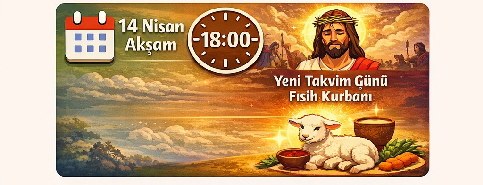
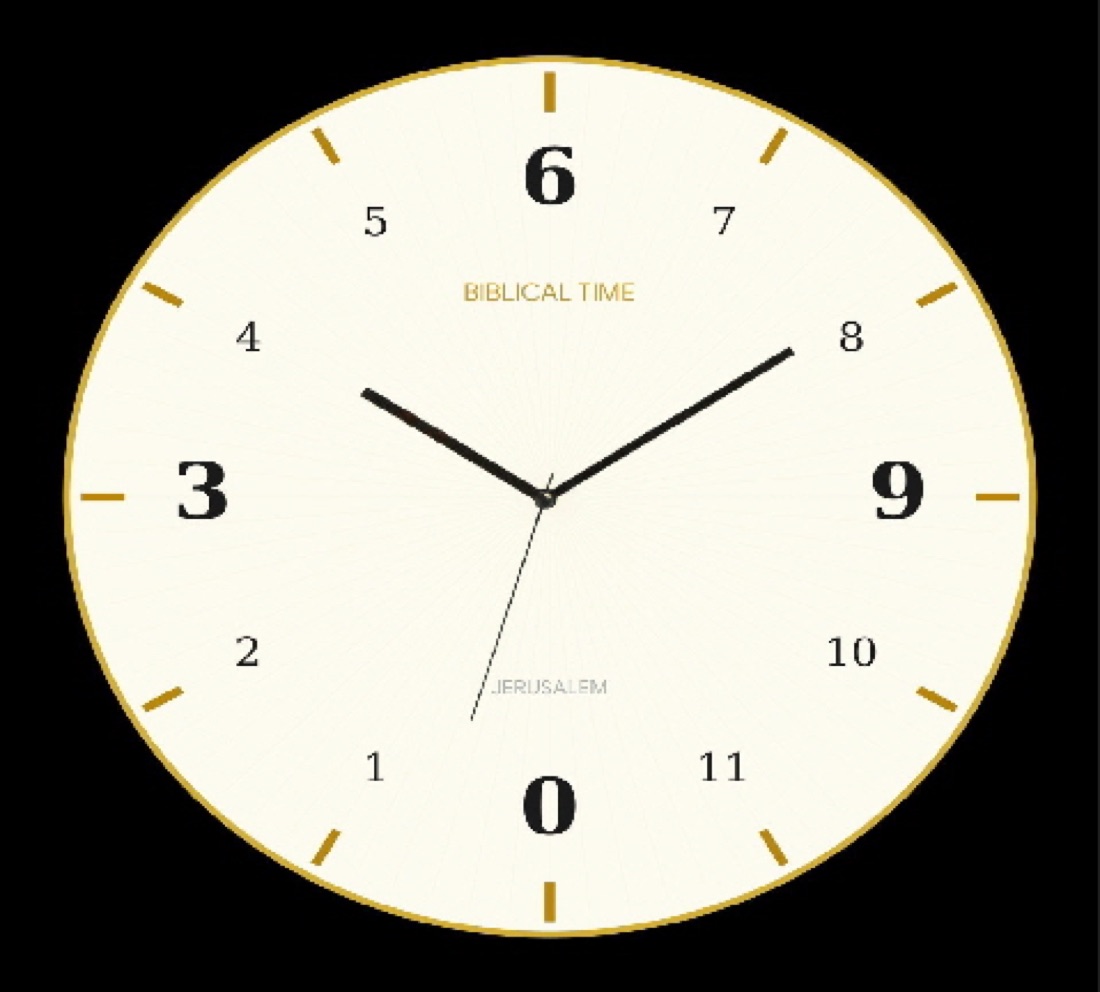
In Israel, a calendar day (24 hours) is divided into two as day and night. (Torah-Genesis 1:3-5) 12 hours of night, 12 hours of day. For us, a day is 24 hours, and the new day begins at 00, that is, after 24. In Israel, however, the new calendar day begins at 18 in the evening, according to us. For them, this is the end of the daytime at the 12th hour; that is, the beginning of the night and of a new calendar day is 00, and it is called the first hour of the night. Just as for us the midnight hour 24 is the same as 00, exactly so. The difference is, they live this hour 00 twice in one calendar day, once at night and once in the day. According to us, at 06 in the morning, for them again it is the end of the night, the 12th hour, and the beginning of the day is 00, and this is called "the first hour of the day," but this is only the daytime of the same calendar day. For this reason, in some translations, the hour of Jesus' execution is "around the 6th hour," that is, 12 noon according to us; and the expression "and until the 9th hour the sun was darkened" means 3 in the afternoon. Jesus eats the supper with His disciples on the 13th of Nisan. Again, on the daytime of the same calendar day, the 13th of Nisan, at 12 noon Jesus is executed; according to the Jews, the 6th hour of the day; and around 15 o'clock He gives up His spirit; according to the Jews, this is the 9th hour of the day. (Matthew 27:45-50; Mark 15:33-37; Luke 23:44-46; John 19:28-30) In the evening at 18 by our clock, according to the Jews at the 12th hour, that is, at 00, together with night a new day begins, that is, the 14th of Nisan, the day on which the Passover feast was to be celebrated. Toward evening the sacrifices are slaughtered and eaten. And just as the sacrifices are being slaughtered, Jesus has been sacrificed. (John 1:29; 1:36; Isaiah 53:7; 1 Peter 1:19) And the morning is exactly the day the Israelites came out of Egypt. (Exodus 12:6; Leviticus 23:5; Numbers 9:2; 28:16) Generally at the time of the full moon.
A verse that people think is contradictory occurs in Mark 15:42. There it does not say "Passover," but look at what Mark says:
Now when evening had come, since it was the day of preparation, that is, the eve of the Sabbath (Shabbat). Mark 15:42
There are those who think that with this expression it is as if Passover were past, and that the next day, Saturday, that is, the Sabbath day, is being spoken of. This too again evokes the meaning that they killed Jesus on the 14th of Nisan, the day of the Passover feast. Let us first look at what Sabbath/Shabbat means.
The word Sabbath (Shabbat) comes, in origin, from the Hebrew root "shbt" (shābath) and means "rest, taking a break, sitting, stopping." Today we call this "Holiday/days off."
Mark expressed the Passover after the day of preparation on the 13th of Nisan also as 'Sabbath,' which is not wrong. Because on feasts, as on Sabbath days, it meant stopping, taking a break from work, resting. That year, Passover and the Sabbath/Shabbat coincided. It is probably for this reason that John too uses the same expressions.
Since it was the Day of Preparation, the Jews asked Pilate that the legs of the bodies be broken and that they be removed, so that they would not remain on the torture stake on the Sabbath day (for that day was a great Sabbath day). John 19:31
There is nothing wrong with the use of the word Sabbath here instead of Passover. Whether it was a feast or the Sabbath day, the bodies could not remain hanging on the cross until evening. Because the law and the rules were the same. (Deuteronomy 21:22-23; John 19:42) He also characterized the consecutive falling of Passover and the Sabbath by saying it was a great Sabbath day.
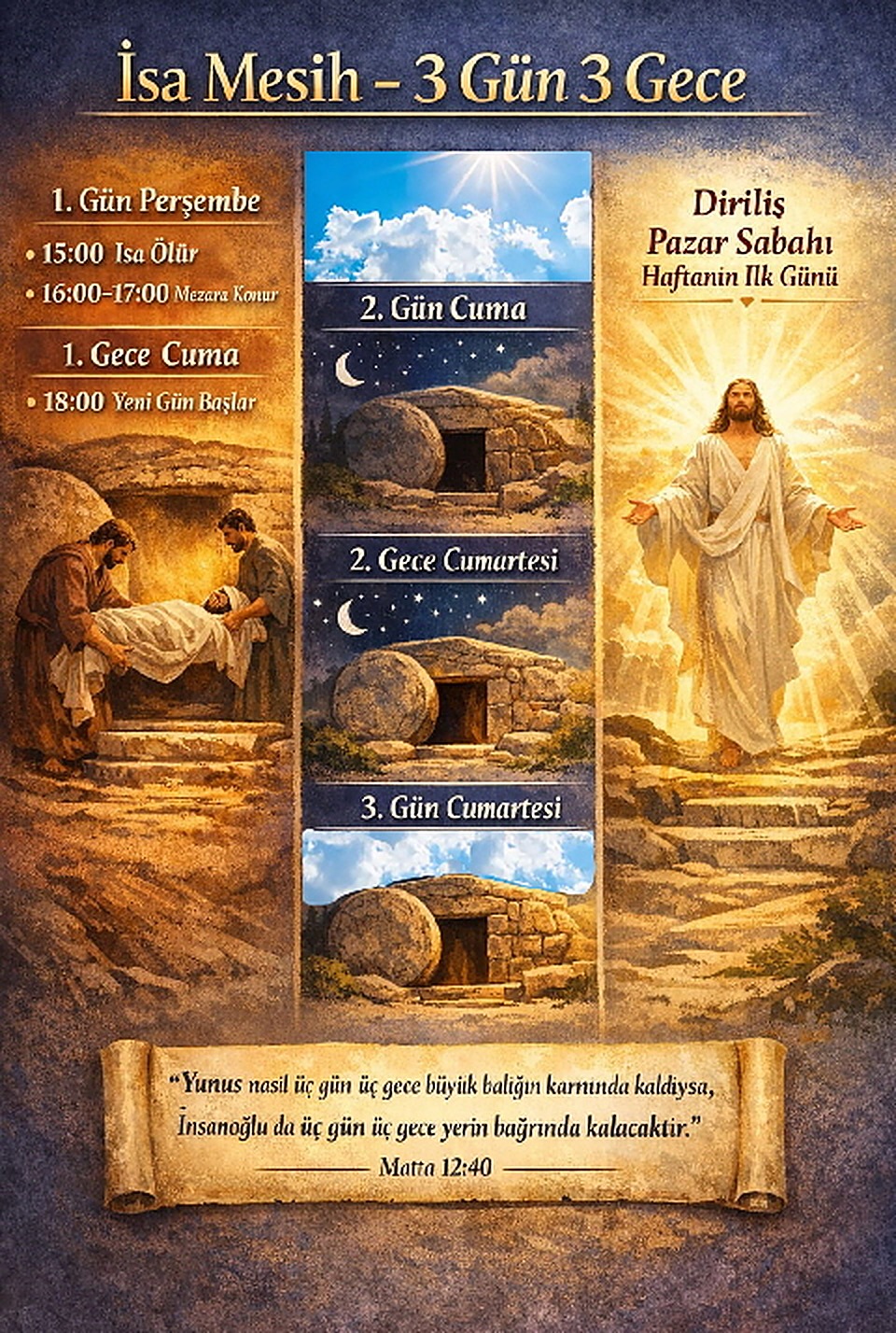
After all these explanations, let us also touch on these words of Jesus Christ that people cannot understand—indeed, about which they say 'there is an error in the Gospels'—which seem inconsistent to them, found in Matthew 12:40.
For just as Jonah was three days and three nights in the belly of the great fish, so the Son of Man will be three days and three nights in the heart of the earth.
In the explanation just now, we described that the Israelites, by saying day and night, divided the 24-hour day into two time periods. But only with this knowledge can we understand the words of Jesus Christ. Jesus Christ ate His last supper with His disciples on the night of Thursday, the 13th of Nisan, and made a new covenant. That same night, perhaps a few hours later, He is arrested at a place called Gethsemane. (Matthew 26:36; Mark 14:32) All night He is put on trial, and they take counsel with one another to kill Jesus. Toward morning, they bind Him and hand Him over to Governor Pilate. (Matthew 27:1) And they too, after scourging Him and sending Him from place to place, upon the insistence of the people, Pilate, though he did not want to, orders Jesus' execution. (Matthew 27:24-26) Around the 6th hour, at 12 noon according to our clocks, Jesus is executed. And around the 9th hour, at 15 o'clock according to us, He gives up His spirit and dies. (John 19:14; Matthew 27:45-50; Mark 15:33-37) It is still the day of the 13th of Nisan. In Matthew 27:57, a rich man named Joseph, when evening had come, asks for Jesus' body and, wrapping it in a shroud, places it in his own new tomb hewn in the rock. (Mark 15:46) By these words, let it definitely not be understood that the 12th hour of the day, that is, 00, evening, had come. Because at that time the 14th of Nisan, the Passover feast, was beginning. No one could carry a body and take it to the tomb on a feast day. It could also have been translated as 'toward evening' or 'exactly the times when night was about to begin.' Because of the feast, they break the legs of the prisoners hastily anyway, so that they would die quickly. Because the 14th of Nisan will begin at 12 noon, that is, at 00, at 18 o'clock according to us. This 14th of Nisan, Friday, means the Passover feast, and the next day, Saturday, was the Jews' Shabbat day. The day after that, for them, was Sunday, the first day of the week, that is, like our Monday. With all these explanations, let us calculate how many days and nights Jesus remained in the heart of the earth.
Day 1: On the daytime of the 13th of Nisan, at the 9th hour (15 o'clock), Jesus dies; toward about the 11th hour, toward 17 o'clock for us, His body is removed,
Night 1: At the 12th hour of the day, that is, at 00, at 18 o'clock according to us, the 14th of Nisan, the Passover feast, begins,
Day 2: The daytime of the 14th of Nisan,
Night 2: The night of Saturday, the 15th of Nisan, the Shabbat begins,
Day 3: The daytime of the 15th of Nisan, still the Shabbat day,
Night 3: At the 12th hour of the day, that is, at 00 (18 o'clock), the first day of the week (Sunday) begins.
Three days and three nights, and as the dawn was breaking, Jesus had already risen. (Mark 16:2-6; Matthew 28:1; Luke 24:1-6; John 20:1-17) This more detailed saying of Jesus was also exactly fulfilled: "He will rise on the third day." Its meaning: the day after exactly 2 full 24-hour days, the 3rd day, at any hour. (Matthew 27:64; Mark 14:41; Luke 9:22; Luke 18:33; Luke 24:7) Jesus Christ also gives this meaning of the 3rd day when indicating the time about when He would die. The style He used is the same. (Luke 13:32)
A baby is not one year old on the day it is born, but this is its first year; expressions like zero years old, zero days, or zero year are not used. 'The third day' means the day two days later. 'The 11th year' means the year ten years later. 'In his fourth year' means the year three years later. 'It was Nebuchadnezzar's first year' means he had only become the new king that year. History is not written with an expression like 'It was Nebuchadnezzar's zero year.' The dates of the Holy Scriptures are written according to this understanding. You can see this detail in the Chronology link on my page as well. (Jeremiah 25:1; Jeremiah 45:1)
Jesus said: "Unless you eat the body of the Son of Man and drink His blood, you have no life in you." (John 6:53)
What did this mean?
Through the sin that came from Adam, which passed to all people—if it can be likened, like a contagious disease—and because of this, humanity became mortal. In the book the Apostle Paul wrote to the Romans, in 5:12:
he says, "Therefore, just as through one man sin entered the world, and death through sin, so death too passed to all people; for all sinned." The Quran sheds an understandable and clear light on this subject. In Surah al-Baqarah 38, after Adam committed sin, God's word to them is exactly as follows.
"...all of you go down from here. (That is, they are expelled from paradise) Then a guide will come to you from Me. From then on, whoever follows the path of that guide of Mine, for them there is no fear"—by saying this, God draws attention to the fact that they must listen to that guide for their salvation.
In Surah Al Imran, in the 59th verse: "Indeed, with God, Jesus is like Adam," it says.
A similar verse also occurs in Surah Ta Ha (the 20th surah), in verse 122. We had emphasized that Moses too spoke similar words just a moment ago. Moses had spoken of a prophet like himself.
All these prophecies, and God Himself, always pointed to a savior. Neither Muhammad nor any other prophet said that this savior was themselves. (Surah al-Jinn 21) We see that this is so only concerning Jesus Christ. According to the truths in the Quran, He is the only one who died and was raised and lives in the presence of God, and He Himself is the Messiah. (Surah Al Imran, verse 55.)
The sacrifice of Jesus Christ delivered all of humanity from the sin that passed from Adam, and consequently from death—it delivered us. Of course, all of these were God's will. In Romans 5:19 and 6:10 and 23:
For just as through one man's (Adam's) disobedience the many were made sinners, so also through the obedience of one (Jesus Christ) the many will be made righteous.............For (Jesus) the death He died, He died to sin once for all.......For the wages of sin is death; but the gift of God is eternal life in Christ Jesus our Lord (our teacher). (Hebrews 10:4)
Therefore, we should attach value to this day, the day of Jesus Christ's death, in order to appreciate and commemorate what God did for us humanity. By doing this, we will have glorified not the Christian world, but God.
One day before the Passover feast (the 13th of Nisan), at night, Jesus Christ took bread, said a prayer of thanksgiving, broke it, gave it to His disciples, and said: Take, eat, this is My body. He took a cup, gave thanks, and giving it to them, said: This is for all of you. Because this is My blood, the blood of the covenant, poured out for the sake of many for the forgiveness of sins. (Luke 22:14-20)
Do you remember that above, Jesus said: "Unless you eat the flesh of the Son of Man and drink His blood, you have no life in yourselves. Whoever eats My flesh and drinks My blood has eternal life"? (John 6:53-54)
Again, the bread eaten here and the sip of wine drunk have symbolic meanings. What is meant to be conveyed is that Jesus' body was sacrificed for our salvation, so that all who believe might have eternal life. The word that God, who cannot lie, said to Adam: "If you eat from this tree, you will surely die" (Torah-Genesis 2:17) could not be taken back. God, who is just, could only forgive Adam's offense if a flawless sacrifice, an atonement, exactly like Adam, were paid. For this reason, in the Quran and the Gospels, Jesus is likened to Adam. When God created Adam, He created him flawless. Flawless, but with free will. Not only Adam, but God also created all His angels living in the heavens, in the form of hosts, flawless but with a free will. For this reason, not just anyone could sacrifice himself for Adam. Only one who was flawless like Adam could do this. It is for this reason that Jesus has no earthly father and that His birth too took place in the form of a miracle.
The Holy Scriptures draw attention to the fact that He lived in the heavens before He was born, and indeed that, as the first of those created, He was God's spokesman. In John 1:1 and 14 it is written as follows:
In the beginning was the Word (the Logos, that is, Jesus). The Word was with God, and the Word was a god. (Many translations use the word God instead of god. In reality, this is not wrong. Both have the same meaning. But one must not do as the Christian world does, in its fondness for confusing Him with the Almighty God. (John 10:32-33). In the continuation of John 1:14, it says as follows: The Word became flesh and lived among us. Here John clearly spoke of Jesus. We cannot take up many more proofs, because I take care to keep my writings as short as possible.
These days the Christian world, with rabbits and eggs, under the name of the Easter feast, does everything far from Jesus' command. By now, from their chocolates to their candies, there are rabbits and eggs. And almost no one who passes as a Christian knows its meaning, and those who do know say that it is a pagan custom. But we want to celebrate this day in accordance with God's desire and Jesus' commands before His death.
Who may drink of the wine and eat of the bread?
The Israelites were required to keep this feast called Passover in order to commemorate the day they were delivered from slavery. God wanted us to understand that this day pointed to a future event, that is, that the Passover sacrifice, celebrated for hundreds of years, was Jesus Christ. And of this sacrifice, not only the Israelite, but at the same time every man who was circumcised, and his family, could eat. So, what did Jesus say? Who was to drink His blood and eat His flesh? Everyone. Did He distinguish a certain class? Yes. He rightly separated from one another those who believe and live worthy of this sacrifice and salvation, and those who do not believe and turn their backs on a manner of living worthy of it.
The Christian world—as they say, "they have overdone it"—it is exactly like that. They give these symbols at all times and to everyone. Of course, everyone who wishes to take may take; this cannot be prevented. But just as the Passover sacrifice had its law, this too had its conditions. What were they?
In those times, circumcision was performed; now, however, in place of the circumcision of the body, there is Baptism, which means dying from our sins and being raised again. That is, the circumcision of our hearts. Baptism too is a word, a proclamation, that accepts that we are all sinners and turns us to repentance. We are all sinners, but the Apostle John emphasizes that there is a limit even in this. In 1 John 5:17, by saying "All unrighteousness is sin; there is sin that does not lead to death," he distinguishes between sins.
We all commit sin, but our sins that do not lead to death are not an obstacle to our taking of these symbols. If we are living a life worthy of God and of Jesus Christ's death for us, then taking of these symbols is necessary and obligatory for us. Not taking of the symbols means great rudeness and disregarding the sacrifice of the Messiah. Along with this, on the contrary, as 1 Corinthians 11:27 says: "Whoever eats the bread and drinks of the wine in an unworthy manner has committed an offense against the body and blood of the Lord," it also reads. In short, those who commit sin that leads to death, even if they have been baptized, must not take of these symbols until they repent and correct themselves.
What are these unworthy things?
By now, many things are not at all so hidden. Even mafias gather in church while shedding the blood of many people. Or soldiers, before going to war and shedding the blood of many innocent people, taking of these symbols and praying in church does not make us say, "These are worthy of the blood of Jesus." If, in their knowledge, we do not acknowledge God; if we are full of every kind of unrighteousness, evil, greed, hatred, jealousy, lust to kill, strife, deceit, malice; if we are gossipers, slanderers, haters of God, insolent, arrogant, boastful, producers of evil, disobedient to parents, without understanding, unfaithful to our word, devoid of love, merciless, possessed of pagan habits; if, knowing that those who behave so deserve death, we not only do them but also regard with sympathy those who do them, then let us not regard ourselves as worthy of the blood of Jesus. (Romans 1:28-32) Jesus, in fact, did not teach us to do these things. To do these things and still partake of those symbols can be nothing but mockery, and one must not forget that it is written, "God is not mocked." Those who do this and similar deeds, God does not regard as worthy of taking of the symbols. It is certain that there are also, as is written in the Gospel of John, sins that do not lead to death. On this too, everyone must decide with their conscience, without deceiving themselves. Because, whether little or much, we have all done and are doing these things. There is doing them always, willingly and knowingly, as if having made them a profession; and there is also doing them without planning, without knowing, unwillingly, with our momentary foolishness, or being overcome by our flesh, by our emotions, and then regretting it. Of these differences, one clearly leads to death, while the other helps us to take refuge in God's mercy.
In this Christian religious chaos, there is one group I know of, the Witnesses, who reject the symbols. And on this, I can find nothing to say other than: "This means that they do not accept this salvation." According to them, the blood of Jesus was poured out as if only for the 144,000 people who will live in the heavens! And with this belief, they have forbidden these symbols to all their members. At the same time, this means rejecting the blood of Jesus. I will state again: the Witnesses, on this matter as on many matters, do as they are commanded by their governing bodies. And they are obliged to do so; otherwise they are expelled from that religion, and none of them will speak with the person anymore!
Humanity is quite eager to become a robot. They too show, with much boasting, to their governing bodies, the obedience that the soldiers, officials, and police of every state are forced to show. Let us also not forget: people obey what is evil, but in doing something good they are very skeptical, slow, and cowardly! By now, in doing what is good and right, they split hairs. Knowingly or unknowingly—only they themselves know—the Jews are, for some reason, quite fond of putting Moses, the Muslims Muhammad, the Christians Jesus, and the Witnesses their governing bodies, in the place of God. Unfortunately, the facts and their practices being so, even though they give all glory to these persons rather than to God, they also hate those who speak this truth! I do not know about the governing body, but if there is one thing I do know, it is that neither Moses, nor Muhammad, nor Jesus asked such a thing of anyone. If they took this yoke upon themselves of their own accord, what can we say! But let us never forget: whom we wish to please, and whom we fear greatly, from that one we will also receive our recompense!
When is it to be celebrated?
Toward evening, after the sun has set, just as Jesus commanded us, on the night before Jesus' death, we should commemorate this day with gratitude. These may be matters that you who read these pages have perhaps never even heard of. But there is still time before you to make preparations and to comply with God's will and the warnings of all His prophets. Whatever you may have done until now, whoever you may be, from whatever language and nation you may be, whatever age you may be, learn what God's will is, and while celebrating this day together with the baptism that symbolizes repentance from your sins, by taking a sip of the wine that represents Jesus' blood and a morsel of the bread that represents His body, do strive to show your gratitude and your faith. By your way of living and your thoughts, show that you are worthy of the Lord.
There is salvation in no one else. For there is no other name given among men under heaven by which we can be saved.......Acts of the Apostles 4:12
Behold, the days come, saith the LORD, that I will make a new covenant with the house of Israel and with the house of Judah: not according to the covenant that I made with their fathers in the day that I took them by the hand to bring them out of the land of Egypt; which my covenant they brake, although I was an husband unto them, saith the LORD: but this shall be the covenant that I will make with the house of Israel after those days, saith the LORD, I will put my law in their inward parts, and write it in their hearts; and will be their God, and they shall be my people. And they shall teach no more every man his neighbour, and every man his brother, saying, „Know the LORD“: for they shall all know me, from the least of them unto the greatest of them, saith the LORD: for I will forgive their iniquity, and I will remember their sin no more … Jeremiah 31:31-34
My son, if you accept my words, if you value my commandments and keep them in your mind; if you thus open your ear to wisdom, if you give your heart to being discerning; moreover, if you call understanding to your aid, if you call out to discernment; and if you seek all these as one seeks silver, and search for them as one searches for treasure, then it is that you will understand what the fear of Jehovah (God's personal name) is, and you will find the knowledge of God... Proverbs 2:1-5